Our second night in Guatemala was Christmas Eve, spent at a lovely campground near Huehuetenango where Vrinda and I made palak paneer and homemade naan to celebrate and enjoy each other’s company. Not wanting to keep Santa Claus waiting, we went to bed at our normal hour (between 10 and 11), only to be awoken an hour later by deafening booms. After a moment to gather our bearings, we realized that we were surrounded… by fireworks. What seemed like the whole country awoke at midnight to celebrate the Birth of Christ with even more fervor than Americans celebrate the Fourth of July. Tired but amused, we enjoyed the display for 10-15 minutes (the same could not be said for some of the neighborhood dogs) before trying to fall back asleep (made more difficult by said neighborhood dogs). In the morning, we were gifted some ponche (mixed fruit punch, a favorite drink here, especially with sugar added) by our host and we got to talking about the fireworks. We were largely amused, but he seemed rather disappointed as he told us that while he appreciated the celebratory joy of his countrymen, he was exasperated because he saw the fireworks as part of a larger attitude of neglect for the environment. As he told us, “Our country is beautiful, but if we are not careful and continue to contaminate it, we will lose it.” (Paraphrased because this was in Spanish, but we captured the gist of his concerns.)

Over the past few weeks, we have come to understand his concerns. Not only are Guatemalans extremely firework happy (we saw another large display for New Year’s) but we have heard them nearly every day, from churches, hospitals, neighbors, and more; basically anytime someone is celebrating or bored. Walking the streets, it is hard to miss the remnants of the detonations. These lay alongside a plethora of other garbage, including but not limited to: beer bottles, water bottles, chips bags, packaging boxes, small plastic bags, cans, and much more. Even more than in cities (what city doesn’t have at least a little garbage?), we were appalled at the garbage seen on our hikes. On these mountains - considered sacred by many - it is impossible not to stumble upon piles of garbage at the ends of switchbacks and the bottom of cuts where the water has built up plastic dams. To make matters worse, the accumulation is large enough in some spots that folks consider the area a dump and throw their own trash there as well. In a country famous for its landscapes and growing as a tourist destination - both internationally and domestically, as more families achieve middle class and can afford to travel more — it is not difficult to see the problem reaching a breaking point.
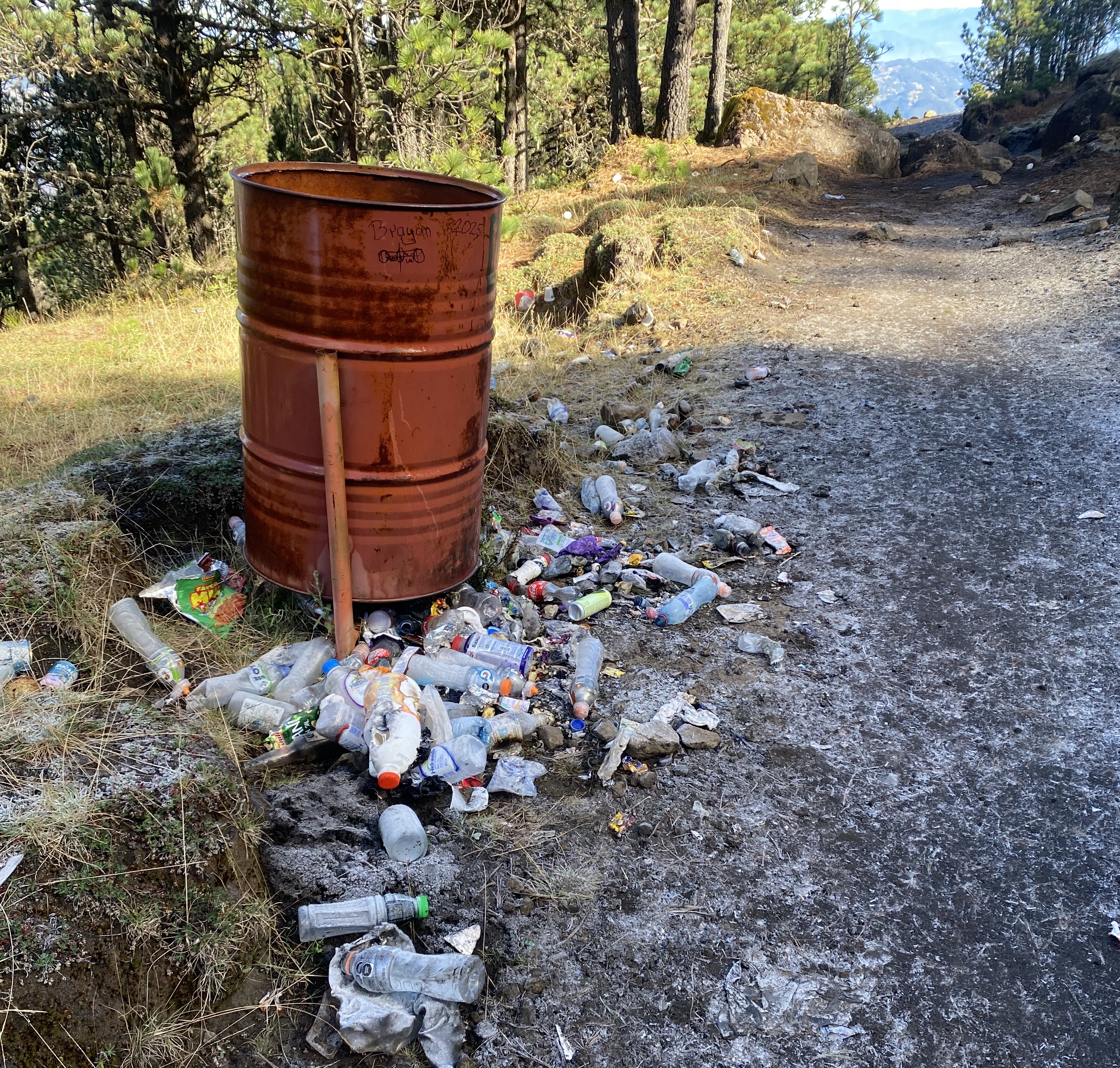
V and I had several discussions about the trash problem: with each other, with other tourists, and with Guatemalans, and each has a different take. On one hand, it is clear that more personal responsibility is required of many, especially in places like national parks where environmental protection and ecosystem maintenance are of more importance. This may be a mix of education - emphasizing carry-in carry-out on hikes for example - and culture setting. Both local groups and the government have begun to work on this; for example, San Pedro La Laguna on Lake Atitlán was the first municipality to ban single-use plastics in 2016 (Atlas Obscura, 2019), but a lot of work is still required. All too frequently, places that post signs “No Tirar Basura” seem to attract even more garbage (although whether the garbage or the sign was there first is a question best left for the philosophers).
Taking a step further up the food chain, Guatemala as a country lacks the infrastructure to handle the amount of garbage being produced. This is true on hiking routes, in small pueblas, and in the country’s capital, where the landfill has engulfed an entire neighborhood (Latina Republic, 2024) and runoff has created islands of garbage in nearby rivers and lakes (Progressive Magazine, 2023) and as far away as Honduras (Mongabay News, 2022). With the garbage polluting the waters and purification infrastructure lacking as well, most Guatemalans do not have direct access to clean water and - in a cycle similar to that in Chiapas - must purchase either expensive purification systems or use plastic water bottles, contributing to the problem. Recently the federal government has begun to enact large-scale clean-up projects such as trash interceptors along the Motagua River (ABS-CBN News, Youtube, 2024; even if you don’t usually click the links, I recommend this video because it’s pretty wild to see the scale), but everyone agrees that garbage removal and relocation is only a temporary solution to a much larger problem.
The largest problem, of course, is plastic. Generated cheaply at a worldwide scale, plastic use has taken over much of the world as the go-to for cheap and easy production, products, and packaging. In Guatemala, plastic is used for nearly everything, from fresh water to cheap household goods to shopping and food bags. Entire stores are dedicated to selling the cheapest plastic items. Many restaurants - including one we worked at - individually wrap each takeaway item in a small plastic bag and then organize everything into a larger one. Plastic items are, of course, useful for their durability and longevity; these same traits mean that, once disposed of, they can take multiple lifetimes to decompose. Instead, they accumulate (United Nations, 2021) in landfills and waterways, neighborhoods and along the road, the top of mountains and the bottom of the ocean. Making matters (much) worse, when these items finally “break down” they don’t magically disappear. Instead, they slowly decompose to smaller and smaller polymer chains, eventually becoming micro- and nano-plastics. At this scale, these pieces are difficult or even impossible to see, and can easily slip past both man-made and biological barriers designed to stop foreign objects of a much larger size. For example, one recent study found that individuals ingest nearly 1000 of these particles a day (Nor et al., NCBI, 2021). Over a week, this may amount to roughly a spoonfuls worth; over a lifetime, nearly 50 pounds (Reuters, 2019). This problem may have devastating consequences for both the environment and ourselves, with very little known about the long-term effects on either given that we only very recently became aware of the problem and the difficulty of studying a control group with no exposure to plastics since they have infiltrated nearly everywhere. However, recent research (BBC, 2025) has suggested that plastic ingestion and accumulation could lead to some cancers, inflammation, hormone imbalance, DNA damage, and brain impairment. All scientists acknowledge that more work is needed to conclusively demonstrate any of these links, but the initial findings are extremely troubling and all point in one direction: we need to reduce our dependency on plastics.
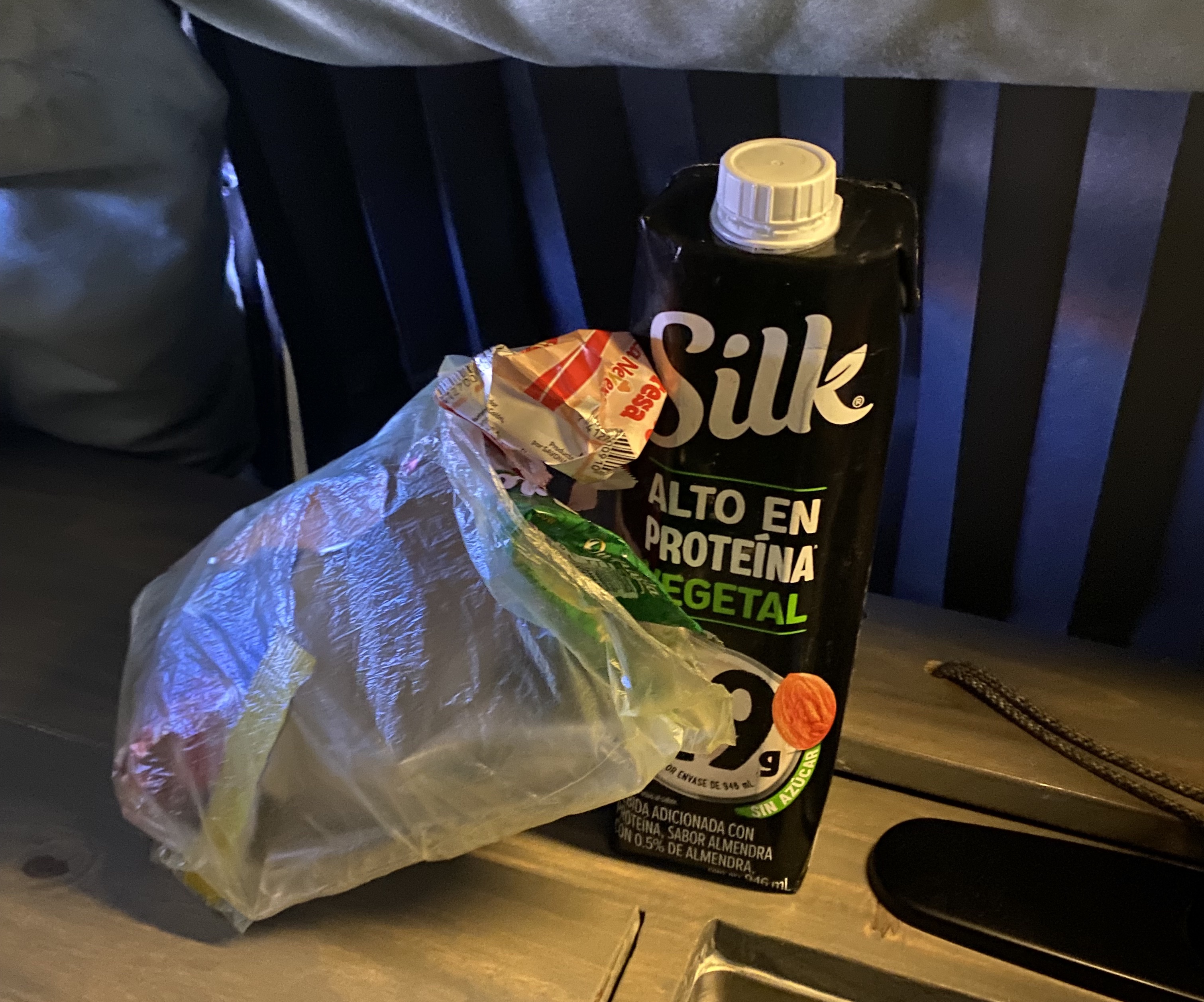
As with garbage disposal, reducing plastic consumption needs to come from all levels of society. On a personal level, minor changes like switching to reusable water bottles and grocery bags can dramatically reduce the amount of plastic used. Buying groceries in bulk, buying locally, and/or, using a sustainable container and refilling it as needed (a service offered by many co-ops!) can minimize the single-use plastic used in transporting these goods. (This is hard!! And we will by no means profess to being perfect either, despite trying our best we are still generating roughly a grocery bag’s worth of waste each week while on the road, especially since we can only buy in small quantities.) Recycling is of course a very useful step, but also not a very sustainable one, as difficulties in sorting, melting, and re-purposing mean that only ~5% of plastic waste gets turned into new things (NPR, 2022). Applying pressure to companies economically by intentionally purchasing goods with less packaging and to the government via voting and advocating for minimizing plastic production and consumption and providing for more sustainable alternatives are both needed, as we will ultimately need those with the most control to change their behavior to confront this problem.
Like many crises of our times, the problem of waste and plastic can feel daunting and intractable; an ugly consequence to the focus on cost and scale that consumed much of the last century and the beginning of this one. To convince you that change is possible, however, I want to leave you with several observations from our time in Mexico City. As recently as thirty years ago, CDMX was one of the most polluted areas in the world (Climate Impacts Tracker, 2024); a perception that many Americans may still hold to this day. Since that time, the city has made incredible strides on many environmental issues and is now a model for more sustainable living at scale. To reduce air pollution, various restrictions limit when cars can drive; we could not drive on Saturdays, Mondays, or before 11am every day. Instead, cycling is now widely encouraged, with bike lanes on nearly every main road, free bike gear at various points around the city, and some roads shut down to cars altogether on Sundays to promote cycling, walking, and roller blading around the city. On plastics, the city has also enacted a ban on single-use plastics (Plastic Pollution Coalition, 2024), and has many waste bins around the city with clear instructions to separate organics and recyclables from garbage designated for the landfill. Perhaps most imaginatively, the CDMX zoo dedicated an entire exhibit showcasing not animals, but plastic waste in the ocean; a startling and vivid reminder of our impact on the world when displayed between the penguins and the sea lions next door. All of this is not to say that the city has solved all of its issues or reached total sustainability. But, a concentrated effort from advocates, citizens, and politicians over an extended period of time can create real change, momentum, and, most importantly, hope that we can live in the 21st century in greater harmony with our planet.